
Shelby County Previous Resident Sources
Different eras leave different evidence behind. A current parcel record supplies the starting land description, while a deed can lead from buyer to seller. Directories and census material address the household question more directly, but they are dated snapshots. Shelby County's Register, Archives, and Memphis Public Libraries each hold part of the backward trail. Start with the period you need, then use the next source only to test or extend the evidence already found.
| Source | Years It Covers | Where Held | What It Shows |
|---|---|---|---|
| Occupant, entry, and survey books | 1819-1962 | Register/Archives and library microfilm | Early ownership descriptions, grants, and surveys |
| Deed index and deed books | Earliest-present at office; deeds earliest-1850 on microfilm; indexes earliest-1933 | Register/Archives and library | Title chain, parties, derivation, and legal description |
| Memphis city directories | 1849-1943 digital; 1849-1994 library run | Register and Memphis Public Libraries | Annual address, occupant, owner, or business clues |
| Suburban directories | 1964-1994 | Memphis/Shelby County Room | Address-to-occupant clues outside core Memphis |
| Memphis census and federal census microfilm | 1865; federal 1790-1920 with indexes/Soundex | Register archive and Central Library | Household members and dated residence clues |
| Sanborn maps and newspapers | Memphis volume 1907-1950; newspapers 1847-present | Library of Congress and Memphis Public Libraries | Structure, lot, real-estate, move, and obituary context |
Current and historical coverage do not share a single online cutoff. The Register states that deeds are earliest-present at the office. When the portal does not return an older instrument or image, use deed books, microfilm, or an Archives contact rather than treating the online absence as the end of the chain.
Start at a Shelby County Parcel
The Shelby County Assessor of Property is the sensible starting point for previous residents research because it connects the present situs address with an owner name, parcel ID, tax mailing address, and parcel attributes. Write down the parcel ID, situs address, legal-description clues, owner, and tax mailing address. The county GIS data also carries map, neighborhood, class, land use, zoning, unit, ZIP, and tax-year fields. Preserve the parcel's displayed spelling before normalizing it elsewhere.
The tax mailing address can be useful, but it may belong to an owner, trust, bank, business, attorney, or other representative. It is not a replacement for the situs address and does not prove a past owner lived at the parcel. A multi-unit property needs the unit field kept apart from the parcel itself. Those distinctions make the later deed and directory comparisons much more reliable.
Trace Shelby County Deed Chains
Use the Shelby County Register property search to move backward from the current parcel. Search the present owner as grantee across a broad date range, then filter for deeds, quitclaims, trustee deeds, and court decrees where appropriate. The latest deed can provide the seller, buyer, recording date, instrument number, book/page, legal description, and a prior-deed or derivation reference. Search the seller as grantee before that transaction date, then repeat.
- Collect the current owner, parcel ID, situs address, and legal description from the Assessor record.
- Search the current owner as grantee in the Register index and inspect the latest relevant recorded instrument.
- Record each party role, instrument type, recording date, document number, book/page, legal-description clue, and image status.
- Search the seller or earlier grantee before the recorded transfer date. Search every named party when a spouse, trust, or entity appears.
- Continue until the portal's coverage no longer serves the era, then move to deed books, library microfilm, or the Archives.
- Grantor and grantee
- The grantor transfers an interest in the instrument. The grantee receives that interest. Either role can be an individual, trust, estate, company, or government body.
- Chain of title
- The sequence of recorded transfers and related instruments that connects one ownership interest to an earlier one.
- Legal description
- The recorded lot, block, subdivision, or metes-and-bounds description. It is often a stronger bridge than a changing street label.
- Derivation clause
- Language in a deed that points to the earlier deed or source from which the present title was derived.
- Criss-cross directory
- An address-to-occupant arrangement that can place a dated listing at a street number. Confirm the Shelby volume and year before relying on it.
- Enumeration district
- The census geography used by enumerators. It helps locate the right census pages after an address has been matched to the correct date and area.
Shelby County Deed Image Gaps
A result without an image has a documented meaning in the Register system. The series may not be available online, may be confidential, may be held outside the Register or Archives, or may need a complete instrument number. Keep the names, date, address, and instrument details from the result. The Register's FAQ says many documents can be viewed or copied online without charge, while unavailable documents can be requested in person, by email, or by mail.
The Register's current office is at 1075 Mullins Station Road, Building W3, Suite W165, Memphis 38134, telephone 901-222-8100. Its Archives listing is 980A Nixon Drive, telephone 901-222-8175, with listed weekday hours of 8:00 to 4:30. Confirm hours before travel. Office copy charges listed by the Register are $0.50 per page, except plats at $1.50 per page; certified copies are listed at $1 per page.
Shelby County House-History Work
Memphis Public Libraries gives house-history research a clear division of labor. The library's Researching Your Home guide points to maps, plats, Sanborn maps, city and suburban directories, Memphis Room files, neighborhood studies, architectural books, manuscripts, photographs, historic-register listings, census, and newspapers. It also says that title-company history, Assessor tax records, and early land deeds are not at the library. Use the library for context and historic occupants, then return to the Register and Assessor for legal property evidence.
Visit the Memphis Public Libraries home-history guide for its local source list.
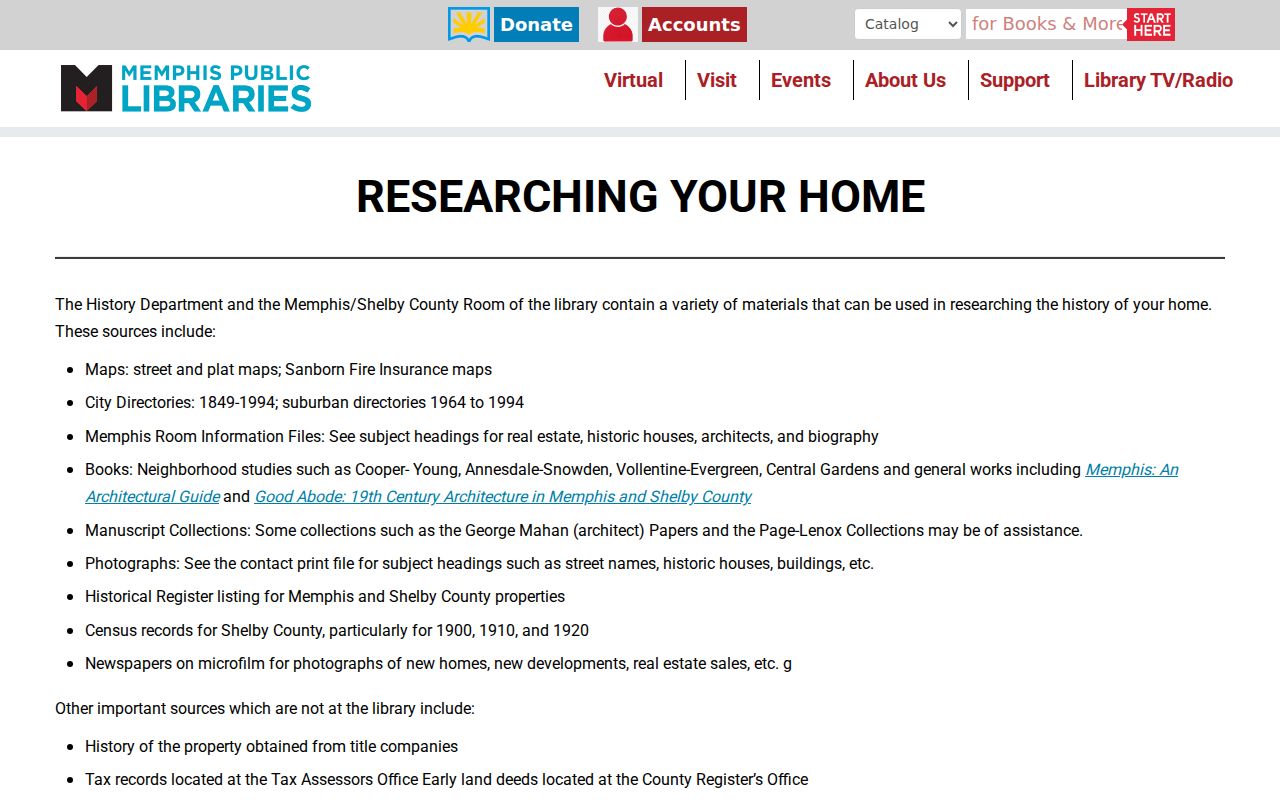
The guide is valuable because it gives a documented way to combine a legal property trail with a dated household trail. The Central Library History Department is on the fourth floor at 3030 Poplar Avenue; staff and volunteers help patrons use sources and equipment but do not conduct the research for them.
Pair Shelby County Directories and Census
Directories work best as annual address snapshots, while census material captures a household on its census date. The Register archive lists digitized Memphis city directories from 1849-1943. Memphis Public Libraries lists city directories from 1849-1994 and suburban directories from 1964-1994. Exact reverse or criss-cross directory dates and publishers were not confirmed in the official sources, so ask the Genealogy Desk or catalog for reverse, criss-cross, telephone, or Polk-type volumes by year.
- Find the known address in the street section for the target year and record the number, spelling, direction, and any printed notation.
- Find the matching name in the alphabetical section to capture the limited household or occupation hints printed by that volume.
- Repeat in nearby annual volumes, noting first and last appearances, moves, and spelling variants.
- Pair the address evidence with the 1865 Memphis Census or the library's 1900, 1910, and 1920 census material when the dates fit.
- Use a deed, permit, newspaper, probate record, or obituary to test whether an address disappearance reflects a move, sale, death, or a directory change.
For the collection shelves and search interfaces themselves, use the Shelby County Directory Book. A directory name is dated evidence of an address listing, not proof of a continuous stay between volumes.
Shelby County Maps Date Structures
Sanborn maps can date the physical setting around a historic address, but they do not identify previous residents. The Library of Congress holds a Memphis, Shelby County volume spanning 1907 to November 1950, Volume 2, with 118 images in sequence. Its record describes building footprint, use, lot, and surrounding street context. Compare a key map and the appropriate sheet with another edition, then carry the address back to a directory or census for people.
Maps also help when a street name changed or an address was renumbered. Compare historic street sections, plats, and map editions, then use the deed's legal description as the bridge. Shelby 9-1-1 assigns current official addresses but does not publish general name-and-address lists, so it is not a historical household source.
Shelby County Household Endpoints
When an address entry disappears, the next evidence may be probate, a death index, an obituary, or a newspaper notice rather than another deed. The Register archive lists probate loose papers from 1820-1900, probate will-book indexes and images from 1830-2000, and death records from 1848-1967. Current Probate Court records include wills from 1900 forward, while older records are at Archives. An affidavit of heirs can also bridge a deed trail when a conventional sale does not appear.
Memphis Public Libraries provides microfilm, local newspapers, and historical research assistance. The Commercial Appeal run is listed from 1847 forward. An obituary or probate file can connect family members and an estate, but a missing directory entry alone does not establish death or relocation. Note: modern vital-record copies remain controlled until Tennessee's statutory opening periods or entitlement rules apply.
Shelby County Address Continuity
Old and current addresses can fail to line up for ordinary reasons. A parcel can be split or consolidated, a unit can be added, and a street label can change. Search the historical and current name forms in directory street sections and maps. If that fails, compare the deed's derivation clause, subdivision, lot and block, parcel ID, and adjacent parcels. Search predecessor and successor parcel IDs when a split or consolidation is evident.
The Register recommends broad address searching because city, ZIP, and subdivision fields are not on every document. Try the whole street without direction or suffix, then use parcel, subdivision, lot, or party-name modes. A result should always be tied back to the legal description before it is assigned to the same physical property.
Limits on Shelby County Previous Residents
Past residents research is a dated record trail, not a way to track a living person. Owners, tax contacts, directory occupants, and census household members answer separate questions. Safe at Home participants and other protected people may be absent or represented differently, and a public record can be incomplete or wrong. Treat uncertainty as a reason to verify with the custodian, not as proof that an address had no occupant.
Lawful personal use. Use Shelby County house history for family history, estate and heir research, preservation, or personal curiosity. Do not combine address records to monitor, harass, intimidate, or harm a person. Tennessee's anti-stalking law, T.C.A. § 39-17-315, can apply to a repeated course of such conduct.